Guide · Christmas Lighting
Will Christmas Light Clips Damage Your Roof?
It’s one of the first things people ask us: how are the lights actually going to stay up — staples? Glue? Something drilled into the house? For roofline lights, the answer is none of those. Here’s how it’s done, and what’s worth checking before anyone hangs anything on your home.
The short answer
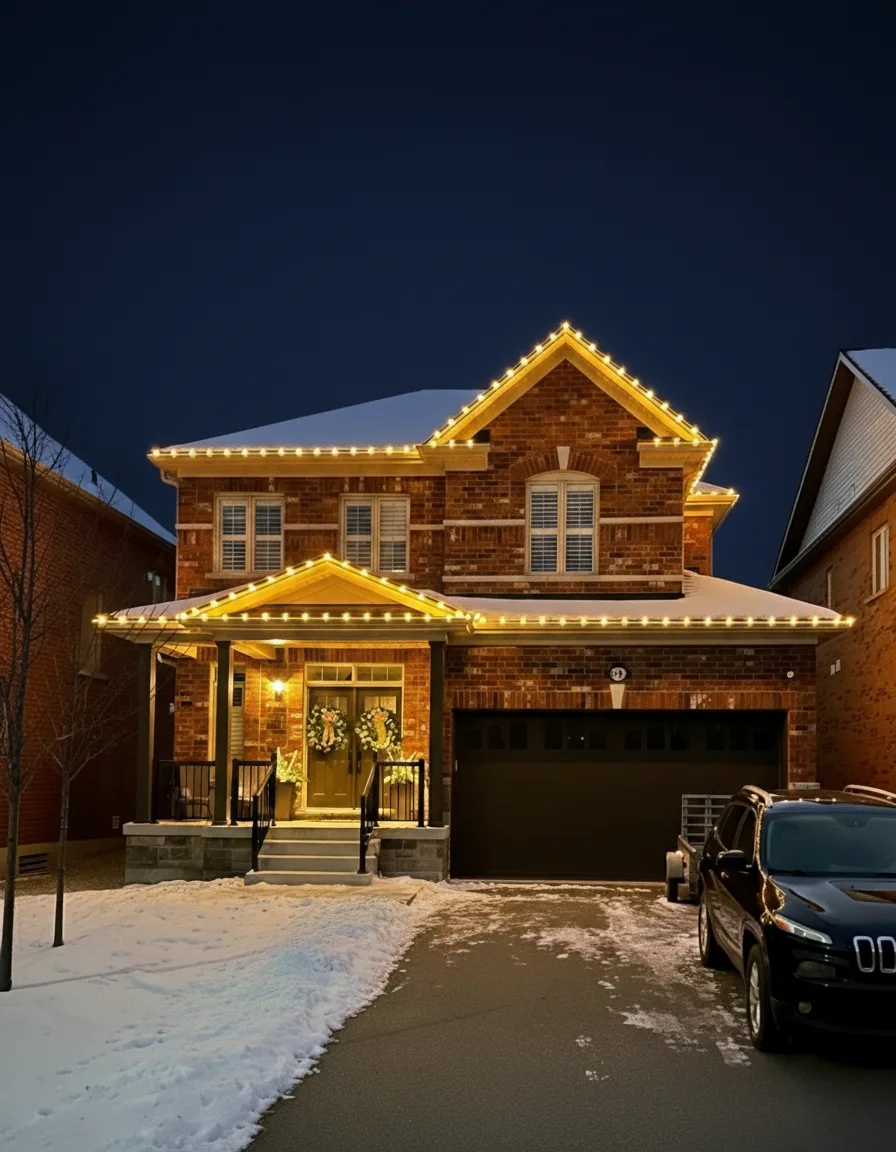
Professional roofline lights go up with plastic clips that grip the gutter, the trim or the edge of the shingles. Nothing is punched through the roof, so there are no holes to let water in and nothing left behind when the lights come down. Done with the right clips, hanging lights shouldn’t damage your roof. To date, we haven’t had a damage complaint.
Staples, nails and glue
These are the methods people picture, and they’re the ones to avoid on a roofline. Roofing manufacturers are blunt about it: any penetration through your roofing materials can lead to leaks.1,3 A staple has a second problem — one that misses and goes through the cord can ruin the strand.1 And glue isn’t needed on a roof or gutter at all,1 which matters because it tends to leave residue behind when the lights come down.
To be fair to the tools: there are lighting jobs where a professional does use staples or hot glue. A standard roofline just isn’t one of them. On the rare job where we do use staples, they’re insulated cable staples that hold the wire without piercing it, and we tell you first.
Where the clips go
Roofline lights usually run in one of three places, depending on the house and the look you want:
- Along the eaves line — the classic look, following the edge of the roof.
- Under the soffit — tucked up under the overhang.
- On the shingles — clipped to the shingle edge, common on gables and peaks or where there’s no gutter.3
Clipping onto shingles, the right way
Where the lights follow the shingles, the clip slides carefully under the edge of the shingle. The one thing that matters is not lifting it too far. Each shingle is sealed to the one below it, and that bond is a big part of what gives the roof its wind resistance.4 Shingle makers warn against lifting a shingle in a way that breaks that seal.3 We clip on the shingle, but we don’t break that seal.
Which clips we use
We use commercial clips only, and the clip changes with the surface. Most of our work goes up on Tuff Flex clips. Depending on the house we also use Trigger clips for runs under the eaves, fascia clips for trim, magnetic clips for steel roofs and steel trim (a magnet won’t hold on aluminum, which some gutters are made of),2 and ridge clips along the peak. Matching the clip to the surface is what keeps a line straight and secure without forcing anything.
The same goes for how we stay safe up there: our roof anchors clamp over the ridge instead of screwing into your shingles. Nothing we use puts a hole in your roof.
What winter does
Honestly, winter is harder on the lights than the lights are on your roof. Heavy snow and ice can pull a strand down, and so can a gutter that fills with water and freezes around the line. That’s a repair, not roof damage — and it’s covered. Our No-Lights-Out Guarantee means a strand that fails or comes down is fixed free within 48 hours, all season.
What to check before install
A clip holds onto what’s already there, so it’s worth a quick look up before the lights go on:
- Loose or lifting shingles along the edges.
- A gutter pulling away from the house, or sagging between hangers.
- Soft or rotting trim on the fascia or soffit.
If you know of anything like this, mention it when you book. Our terms don’t cover damage from conditions that were already there, and any concern after install should be reported within 24 hours — so it’s much better to sort it out up front. We carry $2 million in liability insurance and are WSIB covered.
Hanging your own?
The same rules apply. Use plastic clips made for gutters and shingles, and skip the staple gun and the nails. Work gently at the shingle edge: slide the clip under without lifting the shingle far enough to break its seal to the one below.3 If a clip won’t slide on easily, don’t force it — move to the next spot. If you’re planning a display yourself, our planning guide covers bulbs, colours and safety.
Frequently asked questions
Will Christmas light clips damage my shingles?
Plastic light clips made for the job grip the shingle edge, the gutter or the trim without putting a hole in anything. On the shingles, the clip slides under the shingle edge without lifting it far enough to break the sealant bond to the shingle below. That is how professional roofline lights should be hung. To date we have not had a damage complaint. The one thing to mention before install is any shingle that is already loose or lifting, because a clip holds onto what is already there.
Do professional installers use staples for Christmas lights?
Not for standard roofline lights. Staples and professional hot glue have their uses in lighting, but a roofline is not one of them. Ours go up with commercial plastic clips. If a job ever does call for staples, we use insulated cable staples, which hold the wire without piercing it, and only with your okay first.
Where do the clips go?
Along the eaves line, under the soffit, or on the shingles, depending on the house and the look. The clip changes with the surface: we usually use Tuff Flex clips, and sometimes Trigger clips, fascia clips, magnetic clips or ridge clips.
Do you drill or screw anything into the house?
Not for roofline lights — they are clipped, not fastened. Our roof safety anchors clamp over the ridge too, so the gear that keeps the crew safe doesn’t put a hole in your roof either.
What happens if snow or ice pulls the lights down?
It happens in a Simcoe County winter — heavy snow, ice, or gutters that fill with water and freeze can pull a strand loose. That’s a repair, not damage to your roof, and our No-Lights-Out Guarantee covers it: fixed free within 48 hours, all season.
Sources: 1. Dos and don’ts of holiday decorating — CertainTeed · 2. Finding the right Christmas light clips — Christmas Designers · 3. How to hang Christmas lights on a shingle roof — IKO · 4. Shingle sealants bond your roof together — Asphalt Roofing Manufacturers Association